


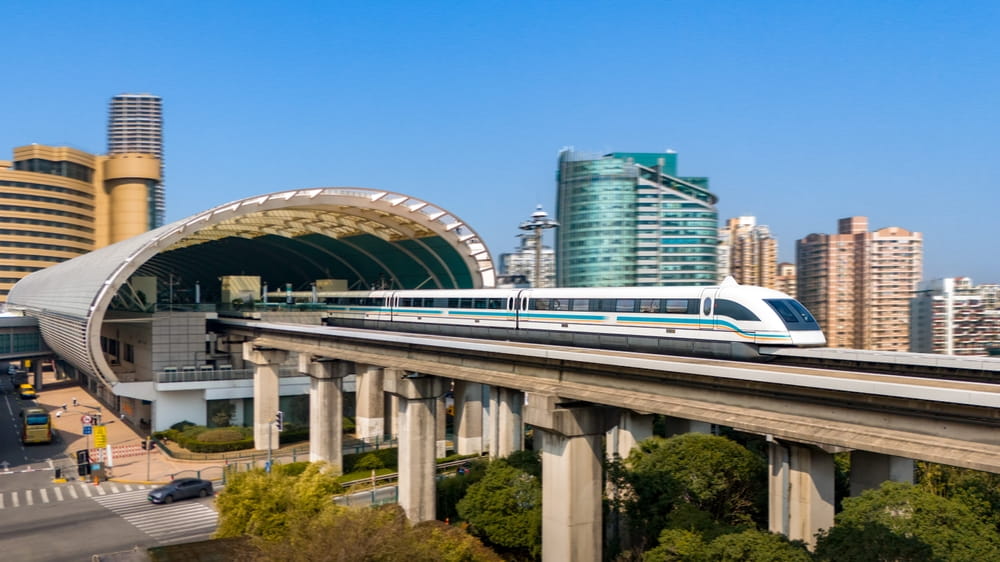
Japan is developing the world’s fastest train, the L0 Series, a magnetic levitation (maglev) train being built by the Central Japan Railway Company (JR Central). The train is expected to reach speeds of up to 603.5 km/h, making it significantly faster than China’s Shanghai Maglev, which operates at up to 460.2 km/h, and far beyond Europe’s fastest conventional trains, such as France’s TGV or Italy’s Italo, which run at around 300–350 km/h.
The L0 Series will operate on the Chūō Shinkansen line, dramatically cutting journey times. Travel between Tokyo and Nagoya is expected to fall to about 40 minutes, compared with at least 86 minutes today. Once extended, the line should connect Tokyo, Nagoya and Osaka, reducing the Tokyo–Osaka journey to roughly one hour.
The technology behind this speed is magnetic levitation, which lifts the train above the track, eliminating friction and allowing it to glide forward using powerful electric motors. While impressive, the system is extremely expensive. The project has already cost around £52bn (€59.9bn) and has been delayed from its original 2027 launch, with current estimates pointing to an opening between 2034 and 2035.
Whether such a train could work in Europe remains doubtful. Maglev systems require entirely new infrastructure, including long tunnels, as they cannot run on existing rail lines. They are also energy-intensive, costly to maintain, and carry fewer passengers than many European high-speed trains. In addition, European rail travel often emphasises comfort, scenery and capacity, rather than extreme speed, except on key business routes such as London–Paris or London–Brussels.
While Japan’s L0 Series represents a major leap in rail technology, the combination of cost, infrastructure demands and differing travel priorities makes its arrival in Europe unlikely in the foreseeable future.

